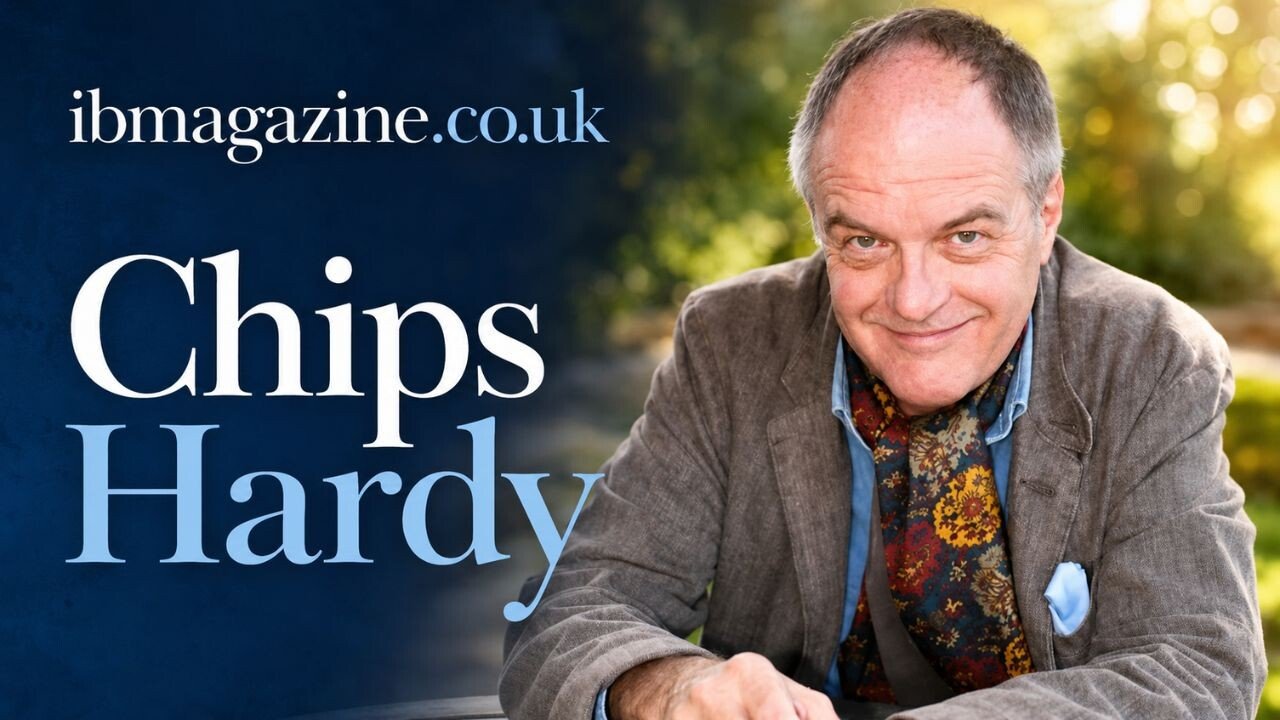
Chips Hardy is a British writer whose public profile is best understood through a long professional arc rather than a single role. Born in Ealing, West London, in 1950, he studied at Latymer Upper School and Downing College, Cambridge, then built a substantial career in advertising before returning more fully to published writing. That shift was not sudden. It grew out of ambitions he had held from an early stage, even while much of his working life unfolded elsewhere.
The available verified material presents Hardy as someone who never abandoned writing altogether. In his own interviews, he has spoken about early setbacks, self-teaching, research habits and the discipline of continuing to write while earning a living in another field. More recent publisher and representative records also show that his work remained active in 2026.
Quick Facts
| Field | Details |
|---|---|
| Public name | Chips Hardy |
| Birthplace | Ealing, West London, England |
| Nationality | British |
| Education | Latymer Upper School and Downing College, Cambridge |
| Profession | Writer and former senior advertising creative |
| Literary representation | The Blair Partnership |
| Agent | Rory Scarfe |
| Confirmed family detail | Father of Tom Hardy |
| Public work | Worked with Blesma, The Limbless Veterans |
His Writing Ambitions Began Before His Advertising Career
Hardy’s route into professional life began with a strong interest in writing. He was educated at Latymer Upper School and later attended Downing College, Cambridge, with his professional profile listing his years there as 1969 to 1972. Those educational details help place the period when his literary interests were already taking shape.
In a direct interview published in 2018, Hardy said that he originally intended to become a novelist. He also recalled writing plays during his school and university years. That ambition did not immediately turn into a straightforward literary career. He spoke about trying to move into professional drama writing and finding that the path did not open up in the way he had hoped.
That early phase matters because it shows that writing was not an afterthought added later in life. It was there from the beginning, even before the better-documented advertising part of his career became central to his working identity.
Advertising Became a Major Part of His Professional Life
After university, Hardy moved into advertising, and that sector became a major part of his long professional career. Publisher biographies describe him as having worked at a senior level in the industry. Leapfrog Press says he later served as an international creative director for JWT, while Chiselbury Publishing describes him in broader terms as having worked at global creative director level.
Those descriptions establish advertising as much more than a temporary detour. It was a serious profession in its own right and one in which he spent many years. At the same time, Hardy’s own comments suggest that writing remained part of his inner direction, even while another occupation occupied much of his daily life.
This combination helps explain the article’s central theme. Hardy did not move from writing to advertising because writing had no place in his life. Rather, advertising became the practical centre of his career for a long period, while the desire to write continued alongside it.
Writing Gradually Returned to the Centre of His Work
The verified record shows that writing later moved back towards the centre of Hardy’s professional life. In the 2018 Lift-Off interview, he described much of his development as a writer as self-taught, while also acknowledging how much he learnt from experienced colleagues. That account fits a career in which writing was pursued persistently, even if it was not always the primary source of employment.
His more recent publication record shows that this long-standing commitment led to substantial later work. Chiselbury Publishing released Seaton’s Orchid on 30 March 2022. In February 2026, The Full Story, created with Oscar Grillo, was published and listed through Columbia University Press. His professional standing is also reflected in his current representation by The Blair Partnership, where Rory Scarfe is listed as his agent.
Another title, Strangers in Paradise, is listed by Chiselbury Publishing for 27 November 2026. At the time covered by this profile, that was a scheduled publication rather than an already released one.
These records document sustained professional writing activity, including published work in 2022 and 2026.
Persistence and Research Shape His Professional Approach
One of the clearest themes in Hardy’s own words is persistence. In the 2018 interview, he spoke openly about rejection and professional near misses. Instead of presenting a polished story of uninterrupted progress, he described a working life in which setbacks were part of the process.
He advised newer writers to accept rejection as normal and to keep going. He also argued that a person can maintain writing as a serious creative purpose even while holding another job. That is a practical idea rather than a romantic one, and it fits the shape of his own career.
Hardy has also spoken in concrete terms about his research habits. He described researching as he wrote, sometimes over a period of months, and paying close attention to small factual details that could make the work feel grounded. That preference for factual texture suggests an approach based on patience and accumulation rather than speed.
He also encouraged writers to keep reading, keep learning from other writers and keep producing work. Those remarks offer useful insight into how he understands craft: not as inspiration alone, but as regular effort supported by study and observation.
Trust and Collaboration Matter in His Creative Work
Hardy’s comments about collaboration add another dimension to his professional outlook. In the same interview, he said that trust is essential to productive creative work and argued that collaboration works best when those involved put ego aside and focus on the quality of the work itself.
He has also said that his writing is driven by an interest in human truths, including contradiction, deception, compulsive behaviour and redemption. These were themes Hardy identified directly when discussing the human material that interests him as a writer. They help readers understand the intellectual concerns that have stayed with him across different phases of his career.
Family Experience Has Informed Some of His Public Work
Some of the most reliable personal information about Hardy comes from first-hand comments rather than generic profile material. It is clearly established that he is the father of Tom Hardy. In a 2017 Sunday Times Magazine interview, Hardy also spoke about Anne, Tom’s mother, and described her as strong and nurturing. He said she played an important role in maintaining stability during their son’s childhood.
That interview offers a limited but useful picture of family life, especially because the comments come from Hardy himself. It does not support a large amount of speculation, but it does provide a grounded sense of the family framework within which he was speaking.
Another important first-hand detail appears in his 2016 comments to Blesma, The Limbless Veterans. Hardy said that his own mother had used a wheelchair. He explained that this gave him some understanding of the everyday realities associated with disability. That family experience later informed part of his public-facing work.
His Work With Blesma Gave Personal Experience a Public Purpose
Hardy’s connection with Blesma is one of the clearest examples of public work linked to lived experience. In material published by the charity in April 2016, he explained that he wanted to give a voice to people whose lives had been altered by severe changes in circumstance.
He also encouraged Blesma members to write from their own experiences, saying that their perspectives were distinctive and worth expressing. His involvement centred on storytelling and on encouraging Blesma members to draw on their own first-hand experiences.
His remarks also included an observation that people living through very difficult circumstances can retain a strong sense of humour. Combined with what he said about his mother’s wheelchair use, the Blesma material shows a practical link between personal background and outward-facing work.
Hardy Has Reflected Publicly on Growth and Self-Worth
In a LinkedIn article Hardy published in January 2021 titled What would I say to my 18 year old self?, he suggested that his younger self did not need continually to prove his worth to himself or others.
The reflection records Hardy’s own retrospective view of self-worth and personal growth.
His Writing Career Remains Active in 2026
The most recent verified updates show that Hardy remained professionally active in 2026. The Full Story, created with Oscar Grillo, was published in February of that year and announced as available by The Blair Partnership on 19 February 2026. Columbia University Press lists the book in its catalogue through the Eris imprint.
A few months later, on 22 June 2026, Hardy appeared in a 45-minute episode of the podcast Insolvency: Dodging Bullets. According to the programme listing, the discussion covered his writing career, creative process, character development and the use of storytelling to explore human behaviour and social issues.
His standing within the profession is also supported by institutional recognition. The Writers’ Guild of Great Britain officially listed Hardy among the recipients of its Best Long Form TV Drama award in 2018. Publisher and representative biographies also credit him with a British Comedy Award for his work with Dave Allen.
These records place him not only in a past career story, but in an ongoing one.
Chips Hardy’s Career Shows a Long Route Back to Writing
The verified picture of Chips Hardy is shaped by continuity rather than abrupt reinvention. He began with literary ambitions, built a long career in advertising, and later returned more fully to writing in published form. His own interviews show that persistence, research, trust and collaboration have been central to how he understands creative work.
The public record also gives a modest but meaningful view of the personal experiences that informed some of his work, particularly in relation to family and disability. By 2026, his recent publications, current representation and interview appearances documented his continuing professional activity as a writer.
You may also read: Simon Fuller Leads XIX and Backs Malaria No More UK.
1 Comment