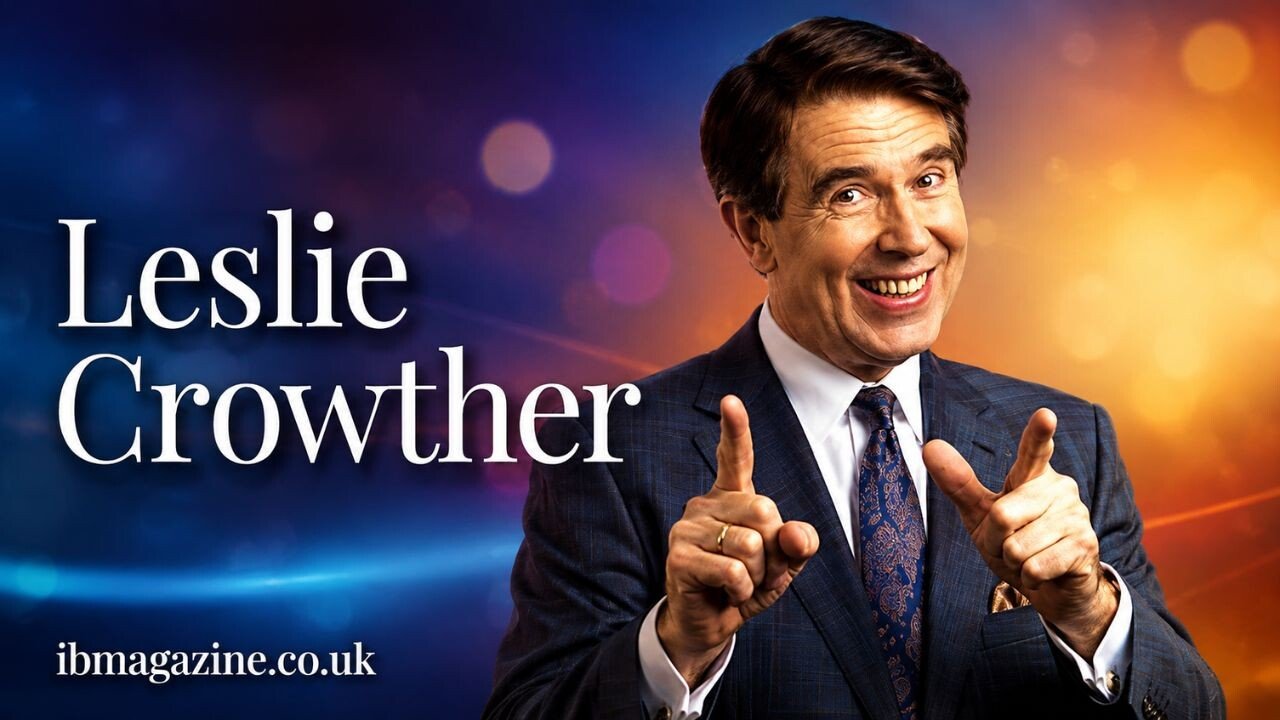
Leslie Crowther was an English entertainer, comedian, actor and television presenter whose broadcasting career stretched from the 1950s into the early 1990s. He became a familiar figure in British light entertainment, working across children’s television, variety, radio and game-show presenting before a serious road accident changed the final stage of his professional life.
Alongside broadcasting, Crowther also developed a substantial record of charitable service. His presidency of the Lord’s Taverners in 1991–1992 is recorded by the organisation itself, while his appointment as a Commander of the Order of the British Empire (CBE) in the 1993 New Year Honours was officially made for charitable services.
| Field | Details |
|---|---|
| Full name | Leslie Douglas Sargent Crowther |
| Born | 6 February 1933 |
| Died | 28 September 1996 |
| Profession | Entertainer, comedian, actor and television presenter |
| Broadcasting work | Television, radio, comedy and variety |
| Charitable role | President of the Lord’s Taverners, 1991–1992 |
| Honour | CBE for charitable services in the 1993 New Year Honours |
| Notable public work | Multiple Royal Variety appearances |
Building a Career in British Television
Crowther’s television career was reported to have begun in 1953, when he was 20. From there, he developed a broad presence within British broadcasting rather than remaining tied to one type of programme or presenting style.
His early work included children’s television and BBC light entertainment, alongside radio and variety programming, presenting, comedy and performance.
By the 1960s, he had become a recognisable figure within British television. Institutional records from the British Film Institute support his status as an established entertainer working across broadcasting, theatre and live entertainment.
This long period of development is important to understanding his later career. Crowther did not appear suddenly as a game-show host in the 1980s. He had already spent decades working across broadcasting, comedy and variety before moving into major game-show presenting.
William G. Stewart, who knew Crowther for many years and worked with him professionally, later described him as well prepared when arriving for work. Stewart’s recollection provides first-hand evidence of Crowther’s professional preparation, although it was Stewart’s assessment rather than Crowther’s own.
Becoming a Leading Television Presenter
By the 1980s, decades of work across entertainment, comedy and broadcasting had preceded Crowther’s move into major game-show presenting.
He became closely associated with a major British game-show format during that decade. His presenting run continued until 1988, and contemporary reporting later identified this period as one of the most recognisable parts of his career.
After that role ended, Granada selected him for another prominent presenting position beginning in 1990. That appointment became his final major regular presenting role before the 1992 road accident substantially changed the course of his professional life.
Crowther was also repeatedly invited to take part in Royal Variety Performances. Official Royal Variety Charity records document appearances across several decades, including the 1970s, 1980s and 1990. One confirmed appearance took place at the Victoria Palace Theatre on 19 November 1984, while another in 1987 involved a performance alongside Bernie Winters.
His presence at these events placed him within a wider British tradition of live variety entertainment, separate from his regular television presenting work.
Charitable Service Beyond Broadcasting
Crowther’s public life was not confined to television. One of the clearest officially documented aspects of his charitable work was his involvement with the Lord’s Taverners, a charity with strong historical links to cricket and entertainment.
The organisation’s own records list Crowther as its president for 1991–1992. That role provides direct institutional evidence of a formal charitable responsibility rather than a general claim that he supported good causes.
His association with the organisation also fitted with a personal interest that people who knew him well had observed. William G. Stewart described cricket as an important private passion for Crowther. Stewart even recalled that cricket was one of the few interests capable of influencing how he approached the timing of rehearsals.
His involvement with the Lord’s Taverners included an official leadership role, with the organisation recording him as its president in 1991–1992.
Recognition for His Charitable Work
Crowther’s charitable contribution received formal recognition in the 1993 New Year Honours when he was appointed a CBE.
The official honours record is particularly useful because it states the reason for the award clearly. Crowther was recognised for charitable services, and the record identified him in connection with his presidency of the Lord’s Taverners.
That distinction separates the honour from awards based purely on television achievement. His broadcasting career made him widely known, but his CBE specifically acknowledged public service beyond entertainment.
The timing was also significant. The honour came shortly after a serious period in his life, following the road accident that had left him requiring major medical treatment. Despite the disruption to his health and career, his charitable work remained part of the official record of his public contribution.
The 1992 Accident and a Major Career Change
In October 1992, Crowther suffered severe head injuries when his Rolls-Royce left the M5 near Cheltenham. Contemporary reporting stated that he required emergency brain surgery and underwent a second operation while receiving treatment at Frenchay Hospital in Bristol.
By 6 October, his condition was reported as critical but stable. The accident occurred while he was still an active television presenter and therefore created an abrupt interruption in a career that had continued for almost four decades.
His recovery was gradual. By 8 December 1992, consultant David Sandeman reported that Crowther had taken his first steps since the crash and was able to talk and eat. These developments represented substantial medical progress, although they did not amount to a complete return to his previous health or professional routine.
The accident substantially changed the final stage of his working life. Before it, Crowther was regularly involved in major television presenting; afterwards, he did not resume his previous regular presenting schedule.
Contemporary police reporting did not establish a definitive cause for the crash. For that reason, explanations attributing it to any particular behaviour or medical factor are not supported by the verified record used for this profile.
Returning to Public Life
Crowther made a notable return to a public stage at the 1993 Royal Variety Performance, roughly a year after the accident.
Contemporary reporting described the appearance as an emotional return and noted that the effects of his injuries were still visible. He performed a short routine, demonstrating that he was able to appear before a major audience again, even though his former regular television schedule had not resumed.
The appearance carried added context because Crowther already had a long history with Royal Variety performances. He had participated repeatedly before the accident, so returning to that setting connected his recovery with an established part of his professional life.
It would be inaccurate, however, to present the appearance as evidence that his career had returned completely to its earlier pattern. His injuries had substantially altered what followed professionally.
Interests and Working Habits Away from the Spotlight
One of the clearest first-person details about Crowther’s interests comes from his own autobiography, The Bonus of Laughter. In a recollection reproduced from that book, he described antique collecting as one of his hobbies.
He was particularly interested in Victorian pot-lids and wrote that he had been collecting them for around 15 years by the time of his 1973 appearance on a major television tribute programme. This is a useful detail because it came from Crowther’s own account rather than from a later celebrity profile.
His interest in cricket is supported differently. It was William G. Stewart, rather than Crowther himself, who described the sport as an important private passion. Crowther’s later presidency of the Lord’s Taverners gives that observation additional context.
Stewart also recalled a professional habit of arriving prepared and already familiar with what was required for a programme. He described examples in which Crowther was willing to reduce his own material when he believed another performer’s contribution would improve the finished programme.
William G. Stewart wrote that Crowther drew support during difficult periods from his family and from what Stewart described as a quiet Christian faith.
Interesting Verified Details About Leslie Crowther
Crowther appeared on the BBC radio programme built around the idea of choosing items for life on a desert island on 7 May 1962. Archive data records Winston Churchill’s The Second World War as his chosen book and a “sport suit” as his luxury item.
The surviving archive information records those selections but provides too little context to support broader conclusions about his political views, beliefs or personality.
The National Portrait Gallery also maintains an institutional record for Leslie Douglas Sargent Crowther and holds a September 1990 bromide portrait of him by photographer Steve Shipman.
Another first-person detail comes from Crowther’s recollection of his 1973 television tribute appearance. He remembered being surprised that such a large production effort had been devoted to him. The remark supports the simple conclusion that he was surprised by the occasion, but it does not justify turning that moment into a sweeping description of his personality.
His repeated Royal Variety appearances are also notable. Official archival records place him in several performances across different decades, demonstrating how long he remained connected with mainstream British variety entertainment.
Leslie Crowther Legacy in Television and Charitable Service
Leslie Crowther built a career that developed from early British broadcasting into nationally recognised television presenting. His professional life covered several decades and included children’s entertainment, variety, radio, studio presenting and major public performances.
His record also extended well beyond television. The strongest evidence comes from official sources: he served as president of the Lord’s Taverners in 1991–1992, and his CBE in the 1993 New Year Honours was awarded specifically for charitable services.
The 1992 road accident changed the final stage of his career, but he later returned to public performance and remained part of Britain’s broadcasting history. His verified record presents a figure known not only for a long career in entertainment, but also for formal charitable service recognised at national level.
You may also read: Dawn Neesom Reaches 40 Years Across Newspapers and Broadcasting.