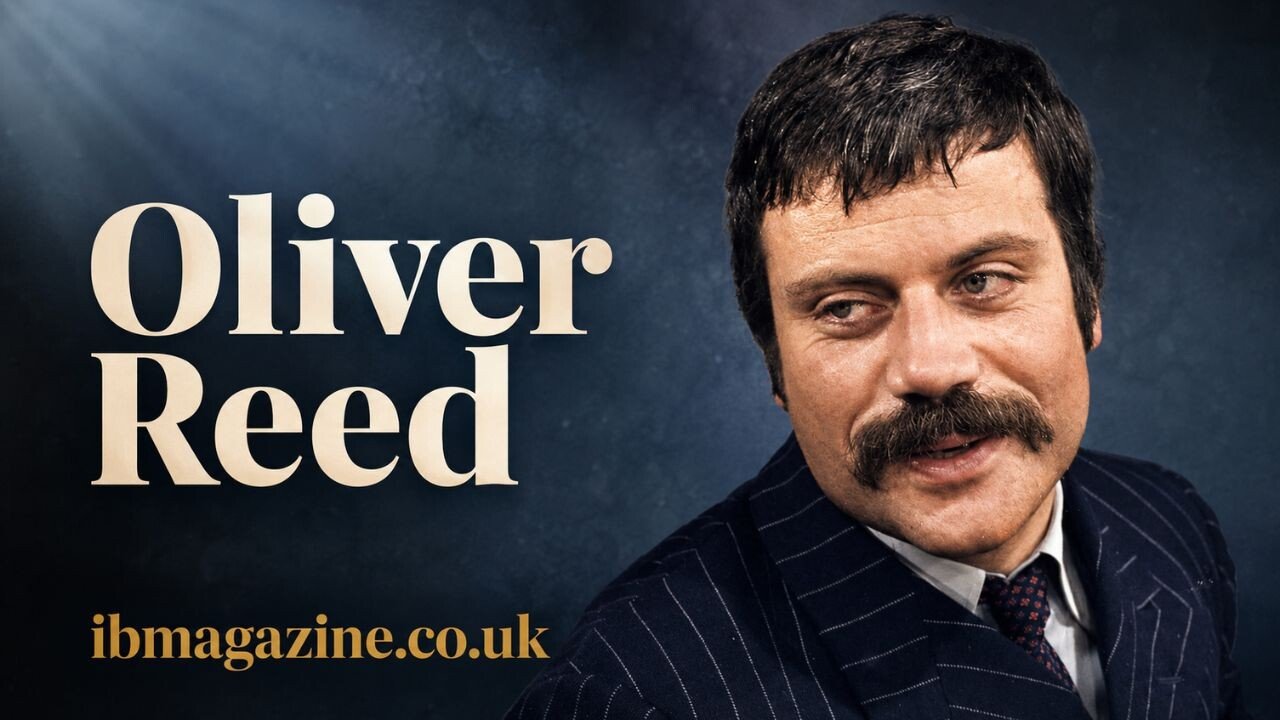
Oliver Reed is often remembered through a highly visible public image, but verified records also preserve a quieter and more personal side of his life. Born Robert Oliver Reed in Wimbledon, he attended Ewell Castle School, competed successfully in athletics, completed National Service and later spoke openly about living with dyslexia.
His final years were closely connected with Churchtown in County Cork. First-hand recollections from his son Mark describe a father who valued manners and presentation at home, while Reed’s own recorded comments reveal an awareness of how his public behaviour could affect the people close to him. His years in Ireland provide particularly useful context for understanding the later part of his life without relying on speculation or exaggerated accounts.
| Category | Details |
|---|---|
| Full name | Robert Oliver Reed |
| Birthplace | Wimbledon, London |
| Education | Ewell Castle School |
| School activity | Athletics and cross-country |
| Confirmed sibling | Simon Reed |
| Children | Mark and Sarah |
| Later home | Churchtown, County Cork |
School Years and Early Challenges
Oliver Reed attended Ewell Castle School from 1949 to 1954. The school’s own alumni record documents an active sporting period during these years. He became captain of athletics and competed in cross-country, finishing second in a national junior competition in which the Ewell Castle team took first place.
These details provide a more specific picture of his school years than general descriptions of his early life. His participation was not limited to casual school sport; the surviving institutional record identifies both leadership in athletics and competitive achievement.
Dyslexia was also a documented part of Reed’s personal experience. Reed later discussed the condition himself, making it one of the personal difficulties for which there is direct first-hand evidence rather than only retrospective reporting.
After his school years, he completed National Service in the medical corps. Reputable reporting has linked dyslexia with difficulties he experienced during that period. No individual military personnel record was established in the verified material, so details such as an exact unit, rank or service timetable are not available with the same level of certainty.
Oliver Reed Spoke Directly About Dyslexia
Reed addressed dyslexia personally during a 1979 RTÉ appearance. That archived discussion is significant because it moves the subject beyond later descriptions by journalists or biographers: he spoke about living with the condition himself.
His comments provide direct support for including dyslexia as a genuine part of his personal history. It was not simply a label applied to him after his death or repeated across secondary profiles.
The subject also adds context to the contrast between his documented athletic success at school and the difficulties he faced in other areas. Ewell Castle School’s records show that he could take on responsibility and compete at a high level in sport, while his own later account establishes that dyslexia presented a separate challenge.
Reed discussed dyslexia publicly, providing direct evidence that it formed part of his personal experience.
Making a Home in County Cork
A major geographical change came later when Reed made his home in Churchtown, County Cork. Reputable Irish reporting places him there during his final years, giving Ireland an important role in the closing period of his life.
The Irish Examiner reported that Reed and Josephine Burge acquired the Castle McCarthy estate in 1994. Another contemporary Irish account described him in 1999 as having moved to the Churchtown area roughly six years earlier.
Those accounts do not establish a single precise move-in date, but they agree on the broader picture: north Cork had become his home well before his death.
The setting is important because it was more than a property associated with his name. Later family testimony connects his time there with the countryside and local community. His attachment to the area was strong enough that Churchtown would eventually become his final resting place as well.
What County Cork Meant to Him
Much of the most useful information about Reed’s connection with Ireland comes from his son, Mark Reed. Speaking years after his father’s death, Mark recalled that Oliver felt at home in Ireland and appreciated both the rural landscape and the surrounding community.
That recollection gives a more specific explanation of his County Cork years than simply saying that he owned a house there. According to Mark, the appeal involved the countryside and an ability to participate in community life.
The account is a family memory rather than a statement made directly by Oliver Reed, so it is best understood as Mark’s first-hand perspective on his father’s later years. Even with that distinction, it offers valuable context because it comes from someone who knew his domestic life closely.
Contemporary Irish reporting also described his presence in Churchtown as established enough that local residents recognised him as part of village life. Contemporary reporting and Mark Reed’s recollections both support Reed’s established connection with Churchtown and its surrounding community.
Family Standards Behind His Public Image
Mark Reed’s memories also provide unusually concrete information about expectations inside the family home. He recalled his father placing importance on good manners, clear speech and personal presentation.
The standards he described were specific. Clean fingernails, polished shoes and proper table manners were among the expectations Mark remembered from his upbringing. These recollections offer a domestic picture that differs from the simplified public image often associated with Oliver Reed.
Mark’s recollections describe a structured set of household expectations, including attention to behaviour and personal presentation.
In comments later reproduced by The Guardian, Reed acknowledged that his own ‘explosions’, as described in the source, could hurt people he loved.
That direct admission adds an important first-hand element to the family picture. Rather than relying on outside judgements, it records Reed recognising consequences within his personal relationships.
His View of Public Expectations
Oliver Reed was also aware that the public expected a particular version of him. In remarks preserved in reputable reporting, he said that audiences and the press had come to expect an unruly public persona.
His own comments are useful because they separate what he believed people expected from him from attempts by later writers to define his private personality. He recognised that a public image had developed around him and that it influenced how he was perceived.
His remarks also acknowledged consequences for people close to him, providing a direct account of how he viewed aspects of his own behaviour.
Reed’s remarks establish that he recognised the expectations surrounding his public image and acknowledged that some of his behaviour could affect people close to him.
His Final Connection to Churchtown
Oliver Reed died on 2 May 1999, aged 61, after becoming suddenly ill in Valletta, Malta. Contemporary reporting based on information from a Maltese police spokesman said that he became unwell and died while being taken to hospital.
The earliest reports noted that a post-mortem was still pending. Later reputable accounts identified a heart attack as the cause of death. That sequence explains why the first reports were more cautious than later summaries.
His connection with County Cork continued after his death. Reed was buried in Churchtown Cemetery, in the area where he had spent his final years.
His brother Simon Reed was among the family members who publicly remembered him at the funeral.
Churchtown therefore became connected with both Reed’s later home life and his burial. It was not merely a temporary location mentioned in retrospective biographies but a documented part of the final period of his life.
Oliver Reed and the Lasting Importance of County Cork
The verified personal record of Oliver Reed goes well beyond a familiar public persona. His school history documents leadership in athletics and competitive cross-country, while his own 1979 remarks provide first-hand evidence of the difficulties he experienced with dyslexia.
County Cork forms the other major part of this picture. Churchtown became his home during his later years, and his son Mark remembered Ireland as a place where his father valued the countryside and community.
Reed’s own reflections add another layer. He recognised the public expectations surrounding his image and acknowledged that his behaviour could have consequences for people close to him. His burial in Churchtown ultimately linked the place permanently with the final chapter of his life.
You may also read: Jorja Smith Returned Home to Walsall and Supports Local Youth.