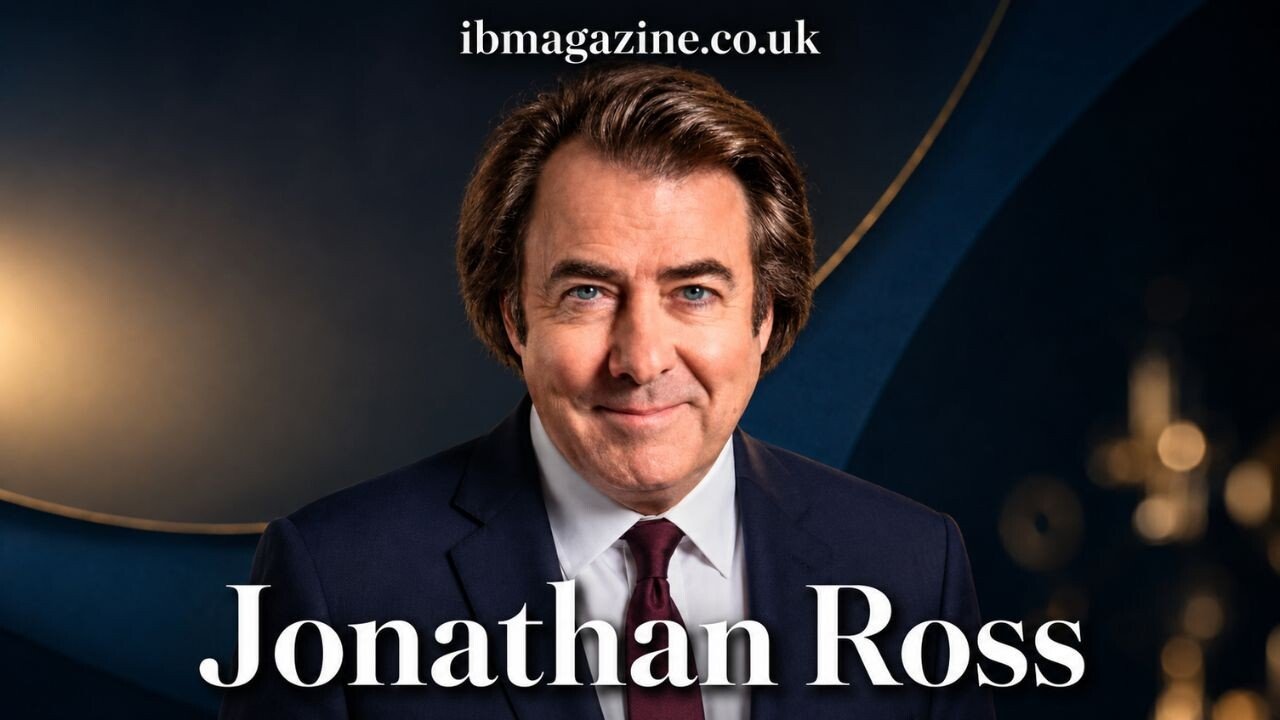
Jonathan Ross developed his public career from behind-the-scenes research work into television and radio presenting, production and writing. His national breakthrough came on Channel 4 in 1987, beginning a broadcasting career that has remained active for almost four decades.
Official records document three BAFTA Television Awards, an OBE for services to broadcasting and a National Television Awards Special Recognition Award. His career also includes a major move from the BBC to ITV, the establishment of Hot Sauce TV and work as a comic-book writer. Direct interviews provide further context about professional accountability, family priorities and the personal changes he has experienced away from the screen.
| Field | Details |
|---|---|
| Full name | Jonathan Stephen Ross OBE |
| Born | 17 November 1960 in St Pancras, north London |
| Upbringing | Leytonstone, east London |
| Education | School of Slavonic and East European Studies, UCL |
| Profession | Television and radio presenter, producer and writer |
| Career origin | Television programme research |
| National honour | OBE for services to broadcasting |
| Production company | Co-established Hot Sauce TV |
Research Work Prepared Him for His Presenting Breakthrough
Jonathan Stephen Ross was born on 17 November 1960 in St Pancras, north London. He grew up in Leytonstone, east London, as one of six children. Some profiles use Camden as a broader description of his birthplace, while Classic FM’s employer profile identifies St Pancras more specifically. Leytonstone refers to where he was raised rather than where he was born.
Ross studied history at the School of Slavonic and East European Studies, which is now part of University College London. His career did not begin with an immediate presenting appointment. He first worked as a television programme researcher, gaining experience behind the scenes before becoming a recognisable on-screen figure.
His national presenting breakthrough arrived on Channel 4 in 1987. UCL’s institutional profile identifies this role as the point at which he became nationally known as a presenter.
His progression from programme researcher to presenter establishes that his on-screen career followed earlier behind-the-scenes television work.
BBC Work Established His National Broadcasting Profile
Ross subsequently developed an extensive career across BBC television and radio. His Friday-night chat programme began in 2001 and continued until 2010, providing a regular platform for interviews, topical humour and guest appearances.
The programme became one of his most substantial recurring roles. Rather than appearing only as a contributor, he carried responsibility for guiding conversations, maintaining the pace of each broadcast and moving between different guests and subjects.
His television work existed alongside radio presenting and production responsibilities. Institutional profiles consequently identify him as both a television and radio presenter rather than associating him with only one broadcasting medium.
Ross also became involved in the production of his programmes through Hot Sauce TV. That connection placed part of his career beyond presenting alone, although his on-screen role remained the most visible part of his work during the BBC years.
Awards and an OBE Marked His Professional Recognition
BAFTA’s official awards database records Ross as the winner of the Television Award for Entertainment Performance in 2004, 2006 and 2007. All three awards recognised his work on his BBC chat programme.
The British honours system provided separate recognition in 2005. The London Gazette records his appointment as an Officer of the Order of the British Empire for services to broadcasting. The official entry confirms the reason for the honour without supplying the later investiture date.
UCL made Ross an Honorary Fellow in 2006, connecting his professional achievements with the institution where he had studied. Its current list of fellows identifies him as a television and radio presenter and broadcaster.
A further distinction came in 2012, when the National Television Awards presented him with its Special Recognition Award. These records document recognition from a professional academy, the national honours system, his former university and a public television awards organisation.
His BBC Departure Became a Major Professional Turning Point
Ross announced on 7 January 2010 that he would not renegotiate his BBC contract. In his statement, he said the decision was not financially motivated. The surviving version was published by The Guardian, making it a newspaper-hosted copy of his own words rather than an official BBC record.
His BBC period had also included a serious broadcasting controversy. Material involving Ross, Russell Brand and actor Andrew Sachs was broadcast on 18 and 25 October 2008. Ofcom later ruled on the case and imposed a £150,000 fine on the BBC in April 2009. The penalty was directed at the broadcaster, not personally at Ross.
When discussing the incident in a 2011 interview, Ross accepted that he had handled it wrongly and said he should have apologised immediately. His later account added direct acknowledgement of responsibility to the official regulatory record.
Ross completed his BBC work later in 2010. The departure closed a substantial period of his broadcasting career but did not end his work as a presenter. He moved to a different commercial broadcaster the following year.
ITV Opened the Next Phase of His Broadcasting Work
Ross began presenting a new ITV chat programme in 2011. The move allowed him to continue the conversational format associated with his earlier work while beginning a separate period outside the BBC.
The programme retained a mixture of interviews and current discussion. Ross continued using his knowledge of broadcasting to speak with established public figures while also including less familiar guests.
Official ITV information confirms that the programme reached its twenty-third series in 2026. The continued commission placed his ITV period at approximately 15 years, following the earlier BBC phase.
This chronology separates two significant stages of his career. The first developed within public-service broadcasting, while the second established a long-running position with a commercial network.
Production and Comics Broadened His Creative Work
Ross’s professional activity has not been confined to presenting. He co-established Hot Sauce TV, which became closely connected with the production of his broadcasting work. ITV’s 2025–26 programme information continued to identify the company as producer of his chat programme.
He also moved into comic-book writing. Image Comics officially credits him as the writer of Turf, created with artist Tommy Lee Edwards, and America’s Got Powers, created with Bryan Hitch.
Turf received a collected-edition announcement in 2011. Issues of America’s Got Powers appeared during 2012 and 2013, followed by a collected edition in 2014. Publisher records establish Ross’s authorship independently of his television profile.
The comic work grew from a longstanding interest in illustrated storytelling and collectables. It gave him a creative role built around writing rather than presenting or interviewing.
Direct Reflections Documented Personal and Professional Growth
Ross married screenwriter and producer Jane Goldman in 1988. They have three children: Betty, Harvey and Honey. These details have been discussed by Ross directly and are also recorded by connected institutional and employer profiles.
In later interviews, he credited Goldman with helping him become more comfortable with himself. He also said that fatherhood had increased his capacity for empathy. These were his personal assessments of how family life affected him rather than independent psychological conclusions.
Ross has spoken about maintaining a boundary between his public identity and his life at home. During a 2011 interview, he described the two areas as psychologically separate. The surrounding account indicated that he discussed family matters publicly with the agreement of those involved.
A 2026 interview included further reflections on personal change. Ross said that therapy, fatherhood and periods of public criticism had contributed to his development. He expressed regret about earlier remarks and described himself as having changed with experience.
He also stated that he had not consumed alcohol since 2000. Ross did not describe himself as an alcoholic; instead, he said he had become concerned about his impulse control. That distinction belongs to his own account and does not establish a medical diagnosis.
His comments connect professional experiences with changes in his private priorities. They also offer first-hand context for how he understood accountability after several decades in public broadcasting.
His 2026 Work Demonstrated Continued Broadcasting Activity
ITV brought Ross’s chat programme back for its twenty-third series in early 2026. Official scheduling information recorded broadcasts during February and March, confirming that he remained active in the format that had formed a substantial part of his career.
He also presented a six-part Channel 4 social experiment launched on 2 March 2026. The programme paired strangers with sharply different opinions and required them to complete a shared journey while physically connected.
When Channel 4 announced the project, Ross said he hoped the format could encourage people with opposing outlooks to understand one another. His statement described the intended purpose of the programme rather than establishing its eventual effect.
Channel 4 later described the series as one of its biggest unscripted streaming launches, reporting that the opening episode accumulated more than two million streaming views. This was the broadcaster’s own performance assessment and did not establish whether the programme achieved Ross’s stated aim of encouraging understanding.
The project represented a different presenting responsibility from his established studio work. It required him to guide a structured social competition while continuing his regular ITV commitments during the same period.
A Broadcasting Career Sustained Through Change
By 2026, Ross was still presenting for ITV and Channel 4, 39 years after his national breakthrough. Official awards records and broadcaster schedules provide a clear chronology of continued work through his major move away from the BBC, while his interviews add his own account of accountability and personal change.
The verified record supports the title’s central point: his broadcasting career received formal recognition and remained active across changing networks and formats.
You may also read: Ulrika Jonsson Reflected on Fame Before Choosing Sobriety.