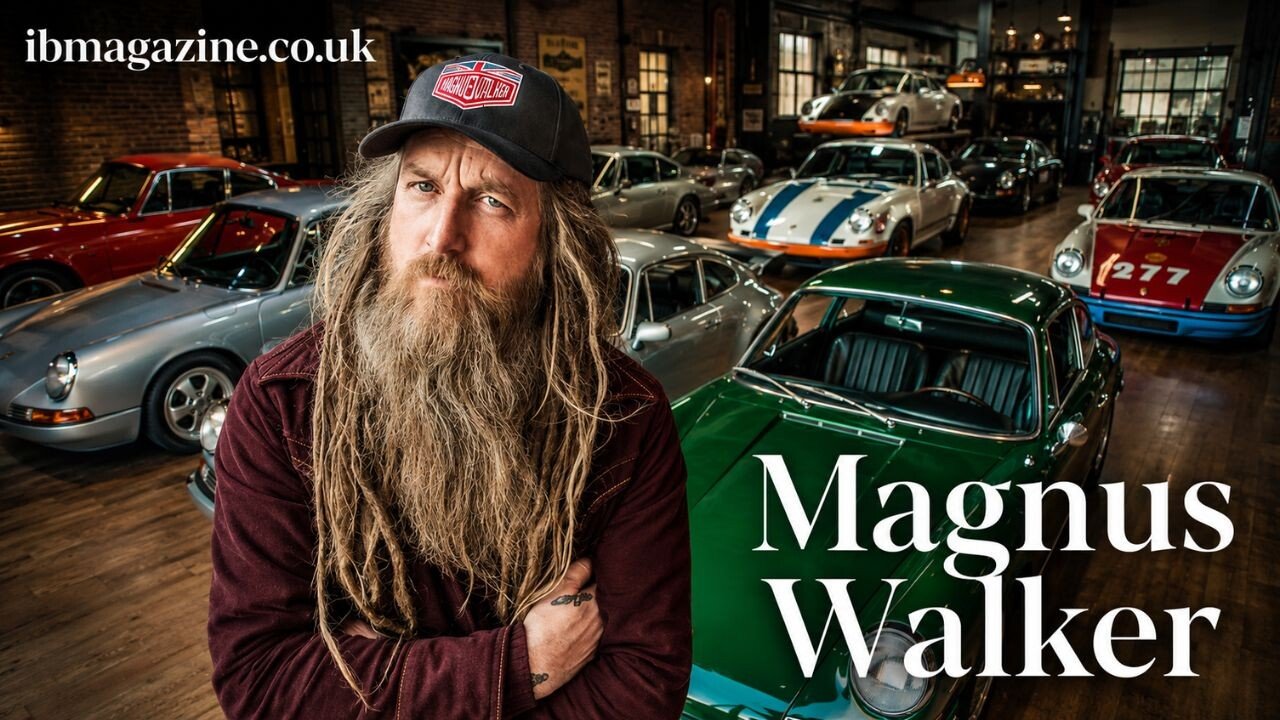
Magnus Walker is best known for a long-running connection with Porsche that developed from childhood enthusiasm into collecting, modifying cars and, more recently, automotive design work. His background, however, did not begin in the motor industry. Born in Sheffield, he left school young, moved to the United States and built businesses in clothing and property-related work before his interest in cars became a major part of his public career.
His own interviews make an important distinction between collecting cars for financial return and owning them for personal enjoyment. Walker has repeatedly described older cars as objects to be driven, experienced and allowed to age rather than treated solely as investments or immaculate display pieces. That outlook has remained central even as his professional work has expanded into design collaboration.
| Field | Details |
|---|---|
| Birthplace | Sheffield, England |
| Professional work | Fashion, real estate and automotive design consulting |
| US base | Los Angeles |
| First Porsche | Bought after years of childhood interest in the marque |
| Collecting approach | Cars acquired primarily for use, enjoyment and personal expression |
| Automotive activities | Collecting, modifying and design collaboration |
| Design collaboration | Long-term partnership with Automobili Pininfarina |
From Sheffield to His First Porsche
Walker was born in Sheffield on 7 July 1967. He has described growing up in a working-class household and said that his father worked as a salesman.
His interest in Porsche began well before he could afford one. At the age of ten, he attended the 1977 Earls Court Motor Show with his father. There, a Martini-liveried Porsche caught his attention and became an early reference point for an interest that would later shape much of his public identity.
Walker left school at 15 and travelled to the United States at 19. He has said that he initially entered the country through Camp America and worked at a summer camp serving disadvantaged children from Detroit before travelling west.
There is a small difference in the surviving accounts of exactly when he became established in Los Angeles. His own TEDx account places his arrival there in 1986, while his official biography describes him as a Los Angeles resident from 1987. The safest chronology is that he moved to America in 1986 and settled in Los Angeles around 1986–87.
Buying a Porsche still came several years later. Walker has said that he purchased his first one in 1992, turning a childhood interest into actual ownership.
Building an Independent Career in Los Angeles
Cars were not Walker’s first source of work in California. Soon after reaching Los Angeles, he began altering inexpensive clothing and discovered that people were willing to buy his customised pieces.
By 1989, he was selling second-hand clothing on Venice Beach. That activity eventually developed into Serious Clothing, which his official biography dates as formally founded in 1994.
The business became part of a broader pattern in Walker’s career: rather than following a conventional professional path, he moved between opportunities that developed from practical experience. He has spoken about instinct and freedom as recurring influences on his decisions.
Property also became important. Walker and his wife and business partner Karen Caid acquired a large former industrial building in Los Angeles as a live-and-work space. Enquiries from production companies led to another business opportunity, and the site developed into Willow Film Locations, which his official biography dates to 2001.
This combination of clothing, property and location work gave Walker an independent career before cars became his dominant public focus. His automotive activity grew alongside those businesses rather than replacing them immediately.
How Magnus Walker Approaches Porsche Collecting
Walker has consistently described Porsche ownership in terms that differ from conventional investment collecting. In a 2026 interview, he said that his cars were primarily a hobby, a form of personal expression and, in his view, an art form.
He has also said that his historical buying decisions were driven by a desire to experience particular cars rather than predictions about which models might rise in value.
That approach extends to how he treats the vehicles after buying them. Walker has argued that cars should be driven rather than preserved indefinitely in perfect condition. Scratches, visible wear and other signs of use are not necessarily defects in his view; they become part of the object’s history.
His preference for patina also connects with his wider interest in older objects. He has spoken positively about things that acquire character through age and use rather than remaining untouched.
The collection itself has never been static. Different reliable sources have recorded very different totals at different points, partly because his holdings changed and partly because some accounts counted only Porsches while others referred more broadly to sports cars.
In 2026, Walker said that he had owned roughly 100 Porsches over his lifetime and that his Porsche holdings had stood at about 30 before his major auction that year.
His Place in Porsche Culture
Walker’s connection with Porsche developed far beyond private ownership. The manufacturer itself has featured him in official editorial material and recognised his unusual approach to collecting and modifying the 911.
That relationship has roots in his childhood. He has recalled writing to Porsche when he was young and expressing an ambition to design cars. Decades later, he was invited to Stuttgart and became involved in events and public-facing activities connected with the marque.
His public profile grew substantially after his personalised approach to older air-cooled Porsches attracted wider attention. Rather than treating every car as something that needed to remain factory-standard, he became associated with modifying vehicles according to his own preferences.
Porsche’s own coverage has documented both his collection and his belief that cars should be used. That official recognition places him firmly within modern Porsche enthusiast culture, although it does not make him a traditional employee or factory designer.
His identity is therefore better understood as that of an independent collector and modifier who developed a recognised relationship with the company rather than someone who followed a conventional career inside Porsche.
Moving From Collecting Into Automotive Design
Walker has gradually moved closer to the professional design work that interested him as a child. His current official biography includes automotive design consulting among his activities.
A significant step came in April 2025, when Automobili Pininfarina announced a long-term partnership with him. The first project disclosed under that relationship involved his design input on a one-off Battista.
Pininfarina’s announcement included Walker’s own reflection that designing cars had been a childhood ambition. The collaboration therefore represented a shift from influencing car culture through private builds and collecting to participating more directly in a formal automotive design project.
His official website also lists other automotive and consumer-brand collaborations, although the extent of each individual partnership varies. The Pininfarina project is among the clearest examples of his move into professionally recognised design work because it was announced directly by the manufacturer.
That development also makes his present role broader than the label “Porsche collector” alone suggests. Collecting remains central to his identity, but design consulting is now part of his verified professional profile.
The 2026 Reshaping of His Porsche Collection
One of the largest recent changes came in March 2026, when RM Sotheby’s conducted the sale of a substantial group of Walker’s vehicles, parts and memorabilia.
The final auction ran from 18 to 25 March 2026 and realised a combined $2 million across 160 lots. RM Sotheby’s reported a 100 per cent sell-through rate and participation from bidders in 30 countries.
Sixteen complete cars were included in the auction house’s final result. Walker’s 1967 Porsche 911 S produced the highest individual result at $308,000. A 1965 Porsche 911 and a 1976 Porsche 911 Carrera 2.7 MFI each achieved $225,500.
Earlier promotional information had referred to 18 cars and 144 lots of parts and memorabilia. RM Sotheby’s final report instead recorded 160 total lots including 16 complete cars, so the final auction-house figures provide the clearest record of what ultimately sold.
Walker did not describe the sale as a rejection of cars. In an interview published shortly afterwards, he said that reducing the collection was a way to lighten his load while pursuing another ambition.
He chose not to reveal exactly what that next goal was. As a result, the sale can be described as a major change in the scale of his holdings, but not as a confirmed retirement from collecting or automotive work.
Facts That Show the Breadth of His Automotive Interests
Although Porsche dominates Walker’s public image, his own comments show that his interests are broader.
In 2026, he identified four vintage Rolls-Royces and a 1977 Corvette among his non-Porsche cars. He also said that he had previously owned vehicles from Lotus, Ferrari and Dodge.
His Los Angeles property remains part of this wider automotive story. In April 2026, Walker said that he still owned the approximately 26,000-square-foot former industrial building and had taken it off the property market after previously offering it for sale.
The warehouse has long been associated with his businesses and automotive activities in Los Angeles. In April 2026, Walker confirmed that he still owned the property after withdrawing it from sale.
Walker also continues to maintain an official online presence. His website links directly to his Instagram account, @magnuswalker, and his YouTube channel, @MagnusWalkerUrbanOutlaw, where his automotive activities remain a central subject.
Magnus Walker’s Continuing Automotive Direction
Magnus Walker’s automotive interests and professional work have developed through several distinct stages: childhood fascination, private ownership, modification, large-scale collecting and, more recently, formal design collaboration.
His own comments provide a consistent explanation for that progression. He has repeatedly emphasised instinct, personal freedom, practical experience and the enjoyment of using cars rather than treating them only as financial assets.
The 2026 auction reduced a substantial part of his collection, but it did not mark a publicly confirmed departure from automotive work. With design consulting now part of his professional profile and a long-term Pininfarina collaboration already established, his verified direction extends beyond collecting alone.
You may also read: Zoe Telford Discusses Motherhood and Life in the Countryside.