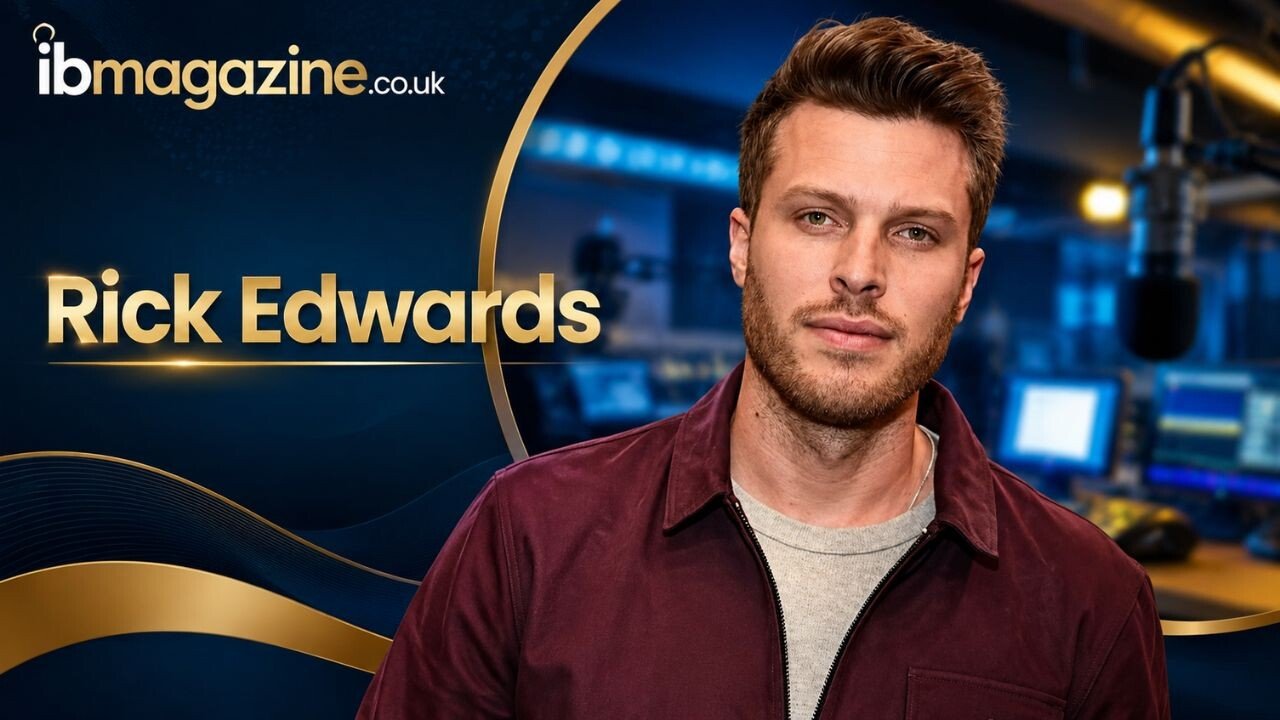
Rick Edwards is a British broadcaster and writer whose work has developed across live radio, science communication and projects designed to improve young people’s understanding of politics. He currently presents on BBC Radio 5 Live, while his wider public record includes voter-engagement work with organisations such as Bite the Ballot, Demos and the Orwell Youth Prize.
His route into broadcasting was not immediate. He studied at Cambridge, changed academic direction during university and spent time tutoring mathematics and science while pursuing professional opportunities. That background later became relevant again when he began developing science-focused work alongside his broadcasting career.
Quick Facts
| Field | Details |
|---|---|
| Full name | Rick Edwards |
| Profession | Broadcaster and writer |
| Born | May 1979 |
| Birthplace | Enfield, north London |
| Education | Studied natural sciences at Cambridge after initially taking mathematics |
| Current broadcaster | BBC Radio 5 Live |
| Public work | Youth voter engagement and science communication |
| Professional representation | Money Talent Management |
Rick Edwards’ Background Before Broadcasting
Edwards was born in Enfield, north London, in May 1979. He later attended Cambridge, where he initially studied mathematics before switching to natural sciences after his first year.
He has explained that university also introduced him to opportunities outside his academic work. He became involved with Cambridge Footlights and student broadcasting, experiences that widened his view of the careers available to him.
In later interviews, Edwards said that he had been disruptive at school despite performing well academically. He recalled having to leave around his GCSE period but being allowed to sit his examinations. His accounts in The Guardian and Big Issue differ slightly in wording, but both support the same broad chronology.
After university, he did not move immediately into a full-time broadcasting career. In a 2008 interview, he said he supported himself partly by tutoring GCSE and A-level mathematics and science while trying to establish himself professionally.
That period included audience warm-up work, screen tests and a graduate scheme at Princess Productions. Edwards later said that reaching the final stages of an early presenting audition, even without getting the job, helped convince him that presenting was a realistic career.
Moving Into BBC Radio 5 Live
Edwards joined BBC Radio 5 Live Breakfast with Rachel Burden in November 2021. His appointment had been announced that September, with the BBC describing him as part of the programme’s new presenting arrangement.
The role placed him at the centre of live news coverage. Edwards has said that he had no formal journalistic training when he moved into this kind of broadcasting and that some of the programme’s most difficult stories required a significant adjustment.
In a 2024 Big Issue interview, he spoke about covering Russia’s full-scale invasion of Ukraine after February 2022. Conversations with people whose homes or relatives were directly affected could be emotionally overwhelming, he said, and he recalled crying on air on several occasions.
He also said that colleagues at 5 Live were supportive during that period. His comment that formal journalism training might have helped him compartmentalise difficult material was presented as his own reflection on the experience.
In September 2023, Edwards also became presenter of Fighting Talk. He had previously appeared on the programme as a guest before taking over the presenting role.
As of September 2026, both BBC Radio 5 Live Breakfast and Fighting Talk remain part of his professional work, although his weekday role is approaching a confirmed change.
How His Science Background Shaped His Professional Work
Edwards’s natural sciences background later became relevant to a separate strand of his broadcasting and writing.
In a 2019 BBC Science Focus interview, he said he had wanted to work in science communication for years but initially struggled to persuade commissioners to give him opportunities in that area. Instead of waiting for a conventional presenting commission, he began creating science-related material himself through writing and audio work.
He described the process as something driven by genuine interest rather than a carefully designed career plan. Creating his own material gave him a way to demonstrate that he could communicate scientific subjects to a general audience.
His professional record subsequently included science-focused broadcasting and audio projects. He also co-presented Eureka!, whose accessible feed has carried no new instalments since May 2023.
The path also connects directly with his earlier education. Having moved from mathematics to natural sciences at Cambridge, Edwards was able to return to subjects that had been part of his academic background while working in a different professional setting.
Why Youth Voter Engagement Became Important to Him
Edwards’s public work has also included a sustained interest in helping younger people engage with politics.
He has said that politics did not interest him when he was younger and that he often felt excluded from political conversations. As he became more involved with the subject, he grew concerned that many young people experienced a similar sense of distance.
In 2014, he worked with Bite the Ballot and Demos on a Voter Advice Application intended to give younger voters clearer information about political choices.
Edwards wrote about the project himself in October 2014. He linked its development partly to conversations with 17- and 18-year-olds while preparing a TEDx Houses of Parliament talk earlier that year.
Demos separately confirmed his involvement in the initiative and outlined the organisations’ respective roles.
His involvement focused on making political information easier to understand for younger voters.
His Work Beyond the 2014 Voting Initiative
The voter-engagement project was followed by further work connected with political understanding.
In March 2015, Simon & Schuster UK published Edwards’s book None of the Above. The publisher described it as an accessible explanation of British politics, electoral choices and the practical significance of voting ahead of that year’s general election.
His involvement with younger people’s political engagement also continued through the Orwell Youth Prize. The Orwell Foundation lists Edwards as a patron and records his participation in Youth Prize events and discussions in 2016, 2018 and 2019.
Those institutional records show that his involvement was not confined to the 2014 voter-information initiative. He continued taking part in projects that encouraged younger participants to discuss politics, writing and public issues.
This strand of his work sits alongside his broadcasting rather than replacing it. It forms part of a broader professional record that includes radio, writing, science communication and civic-engagement projects.
What Edwards Has Said About Career Growth and Public Recognition
Edwards has spoken openly about how his understanding of career opportunities changed as he became older.
He told Big Issue in 2024 that arriving at Cambridge exposed him to student broadcasting, performance opportunities and people who treated ambitious professional goals as achievable. He said this substantially widened his own sense of what he could pursue.
His parents also played an important role in that development. Edwards has said they knew little about the professional environment he later entered but consistently encouraged him. In a 2023 interview with The Guardian, he credited that support with broadening his horizons.
He has described his father in particular as a continuing source of advice and reassurance. That account comes directly from Edwards rather than from outside descriptions of his family life.
His attitude towards public recognition has changed as well. Edwards said he once assumed that being recognised would be enjoyable, but later found that attention from strangers could make him self-conscious. With time, he said, he became more relaxed about it.
Another long-term personal interest he has discussed publicly is backgammon. In a first-person Big Issue article published in January 2026, Edwards said he had played for more than 20 years and preferred face-to-face games because of their social element.
His Current BBC Position and 2026 Changes
Edwards remained active on BBC Radio 5 Live through 2026.
For the 2026 World Cup, BBC Sport confirmed that he would present 5 Live Breakfast from Los Angeles as part of the broadcaster’s coverage. The tournament ran from June to July, adding another major live-broadcasting assignment to his recent work.
A more significant change was announced on 28 July 2026. Edwards and Rachel Burden said on air that they would leave BBC Radio 5 Live Breakfast in December 2026.
The BBC plans to introduce a new breakfast arrangement from January 2027. Reporting on the change also confirmed that Edwards is expected to continue presenting Fighting Talk on Saturday mornings.
No new permanent weekday BBC role for Edwards has been announced for 2027.
His 2025 work also included co-presenting The Inside Track with Matt Majendie during the Formula 1 season. The programme was produced by BBC Studios and ran during 2025 rather than 2026.
Rick Edwards’ Career Now Reflects Broadcasting and Public Engagement
By September 2026, Edwards is approaching a clear change in his BBC schedule: he and Rachel Burden are due to leave 5 Live Breakfast in December, while he is expected to continue presenting Fighting Talk. His wider professional record includes documented work in science communication, writing and youth voter engagement, alongside the radio career that now forms the main part of his public work.
You may also read: Liza Tarbuck Leaves Radio 2 After Nearly 14 Years on Saturdays.
1 Comment