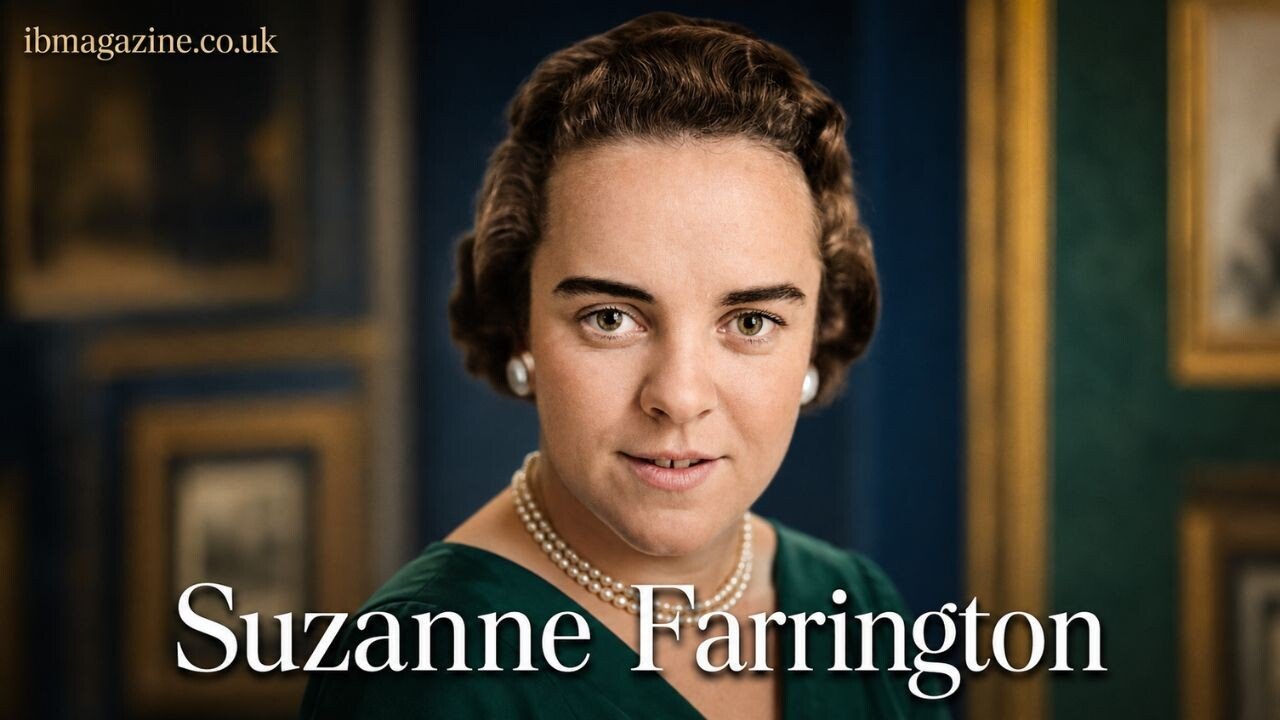
Suzanne Farrington is most reliably documented through her family background and her work with inherited historical material. She was the only child of Vivien Leigh and Herbert “Leigh” Holman, but her own contribution extended beyond that family connection. Correspondence and museum records show that she directly helped place inherited clothing in public collections, while personal papers once in her care later entered the V&A through the Farrington family.
Her surviving letters are particularly valuable. They record how she identified garments, recalled how they had been worn and explained where they had been stored. Those details gave museums important provenance while helping to ensure that the objects remained available for conservation and research.
| Field | Details |
|---|---|
| Full name | Suzanne Mary Farrington, née Holman |
| Born | 1933 in London |
| Parents | Vivien Leigh and Herbert “Leigh” Holman |
| Siblings | Only child |
| Education | RADA diploma, completed in 1953 |
| Husband | Robin Neville Farrington |
| Children | Three sons |
| Public contribution | Donated and documented inherited family material |
| Associated institutions | Fashion Museum, Topsham Museum, RAMM and the V&A |
| Died | 1 March 2015 in Lower Zeals, Wiltshire |
Suzanne Farrington’s Family Background
Suzanne Mary Holman was born in London in 1933. Published sources disagree over whether her exact birth date was 10 or 12 October, while the National Portrait Gallery records only the years 1933–2015. Her birth year and London connection are therefore clearer than the precise day.
She was the daughter and only child of Vivien Leigh and barrister Herbert “Leigh” Holman. The National Portrait Gallery identifies her by her married name, Suzanne Mary Farrington, and holds three portraits in which she appears. Two of these photographs place her with her mother in May 1935.
Another institutional record provides a securely dated glimpse of her childhood. A photograph held through the Topsham Museum collection shows seven-year-old Suzanne with her father outside No. 25 The Strand in 1940. The building later became Topsham Museum, connecting her early family history with an institution that would eventually receive material from her.
Farrington completed a diploma at the Royal Academy of Dramatic Art in 1953, according to the institution’s official graduate catalogue. Reputable reporting placed her at her grandmother Gertrude Hartley’s Academy of Beauty Culture in Knightsbridge, where she worked as an instructress during the late 1950s. Exact employment dates have not been preserved in the accessible records.
Marriage and Family Life
Suzanne Holman married Robin Neville Farrington at Holy Trinity Church in Brompton, London, on 6 December 1957. Archival photographs record the wedding and identify Robin as a member of a Lloyd’s underwriting firm.
The Telegraph reported that the couple had three sons and divided their time between London and Wiltshire.
Robin Farrington died on 13 June 2002. His Telegraph obituary, published the following month, stated that Suzanne and their three sons survived him. Their marriage had lasted for more than four decades.
Reliable reporting offers only a limited account of her later routine. The Telegraph described travel, skiing, tennis and bridge among her interests. These details provide a modest picture of her leisure time without supporting broader claims about wealth, personality or lifestyle.
Taking Responsibility for Family Material
Following her mother’s death in 1967, important family possessions and records passed into Farrington’s care. These included correspondence, photographs, diaries and other personal material, along with clothing that later entered museum collections.
Her role was not limited to keeping these objects privately. Institutional records show that she contacted museum figures, authorised selections and supplied information about the history of particular garments. Her letters connected physical objects with family memories that were not always available from labels or photographs alone.
The surviving correspondence also demonstrates the practical nature of this work. She described how certain pieces had been stored, identified distinguishing details and offered additional items after earlier donations were accepted. These records now help museums trace how material moved from family ownership into their collections.
Farrington also allowed selected researchers to consult family papers. The later transfer of a major archive to the Victoria and Albert Museum expanded that access by placing substantial historical material within a public institution.
Donations to the Fashion Museum
One of the earliest documented examples of Farrington placing inherited clothing with a museum dates from October 1967, when she allowed Doris Langley Moore to select items for the collection later associated with the Fashion Museum in Bath.
A surviving letter from Moore thanks Farrington for making the clothing available. Museum documentation indicates that the selected material included a fitted jacket, a blouse and a coordinated dress-and-jacket ensemble. The records also suggest that several pieces were offered and that Moore chose particular examples for the collection.
This correspondence provides more than a general claim that a donation occurred. It identifies Farrington as the person who authorised the selection and connects the garments directly with museum accession records.
The University of Exeter’s later research project brought this documentation together with related museum material. Although one reference line on the project website gives an inconsistent year, the page itself and the wider institutional evidence place the exchange in October 1967.
Her 1976 Correspondence and Further Museum Donations
Further evidence of Farrington’s museum work survives in letters written to her aunt Dorothy Holman, the founder of Topsham Museum. The correspondence dates from February and March 1976 and concerns several garments that had remained in family care.
In the first letter, she asked whether Dorothy would be interested in receiving a black broadtail dress. Farrington described the garment, included a small drawing showing how it had been worn and explained that it had been kept at her father’s Wiltshire property before being stored by a specialist furrier.
Dorothy accepted the offer. The dress later entered the collection of the Royal Albert Memorial Museum in Exeter, where it has been held at the museum’s off-site storage facility.
A second letter recorded Farrington’s pleasure that her aunt liked the first item. She added a specific memory about a rose-shaped brooch once pinned to its collar and offered two further evening dresses. One was green and cream, while the other was pink. Those garments also eventually passed to the Royal Albert Memorial Museum.
The project metadata differs over whether the second letter was dated 13 or 17 March 1976, so the month and year provide the safest chronology. That minor inconsistency does not affect the central fact that Farrington personally documented and offered the pieces.
Topsham Museum maintained a wider connection with the family. A University of Exeter announcement stated that Farrington visited the museum and contributed material associated with her mother. The 1976 letters remain the strongest first-hand evidence of how she approached those donations.
The Family Archive and the V&A
A major family archive entered the Victoria and Albert Museum in 2013. Its contents included correspondence, diaries, photographs and other personal and professional records covering several decades.
Published accounts differ slightly over who formally transferred the collection. Farrington’s Telegraph obituary described the archive as having been acquired from her, while contemporary museum-sector reporting stated that it was purchased from her three sons. The clearest account is that the archive passed through the Farrington family before entering the V&A.
Once acquired, the material became available through the museum’s Theatre and Performance Collections. The archive brought together thousands of items within a public collection that researchers could consult.
Farrington’s earlier stewardship formed an important part of that chain of custody. She had retained family papers, allowed selected biographers to consult material and participated in donations to regional museums. The V&A acquisition placed a much larger body of records within a permanent public collection.
How Her Contribution Continued After 2015
Suzanne Farrington died in Lower Zeals, Wiltshire, on 1 March 2015, aged 81. The National Portrait Gallery independently confirms the year of her death, while The Telegraph reported the exact date and location. No reliable publicly accessible source reviewed for this profile established a cause of death.
Her museum contribution continued to have a public effect after her death. On 19 March 2020, the University of Exeter announced an Arts and Humanities Research Council-funded project examining collections connected with Vivien Leigh across South West England.
The project brought together material from the Royal Albert Memorial Museum, Topsham Museum, the Fashion Museum and other institutions. It digitised correspondence and documented how objects moved between family ownership and museum care. Farrington’s letters became part of that accessible research record.
Her family’s association with the V&A also continued. The museum’s 2022–23 annual review listed “The Farrington family in memory of Suzanne Farrington” among its major benefactors. The acknowledgement does not disclose the amount or full nature of the support, but it provides official evidence of continuing family involvement in her name.
A Lasting Contribution to Public Collections
Suzanne Farrington’s clearest documented public contribution was her careful handling of inherited family material. She authorised museum selections, wrote directly about individual objects and supplied information that helped establish their provenance.
The Fashion Museum correspondence, the 1976 letters and the later V&A acquisition form a consistent record of possessions moving from private family care into public institutions. University-led research has since made parts of that history easier to examine.
Her contribution is therefore best understood through surviving documentation rather than speculation about her private character. The letters, accession records and museum catalogues establish a practical legacy: historically significant objects and papers were preserved, organised and made available for future study.
You may also read: Davina McCall Uses Her Broadcasting Platform for Women’s Health.