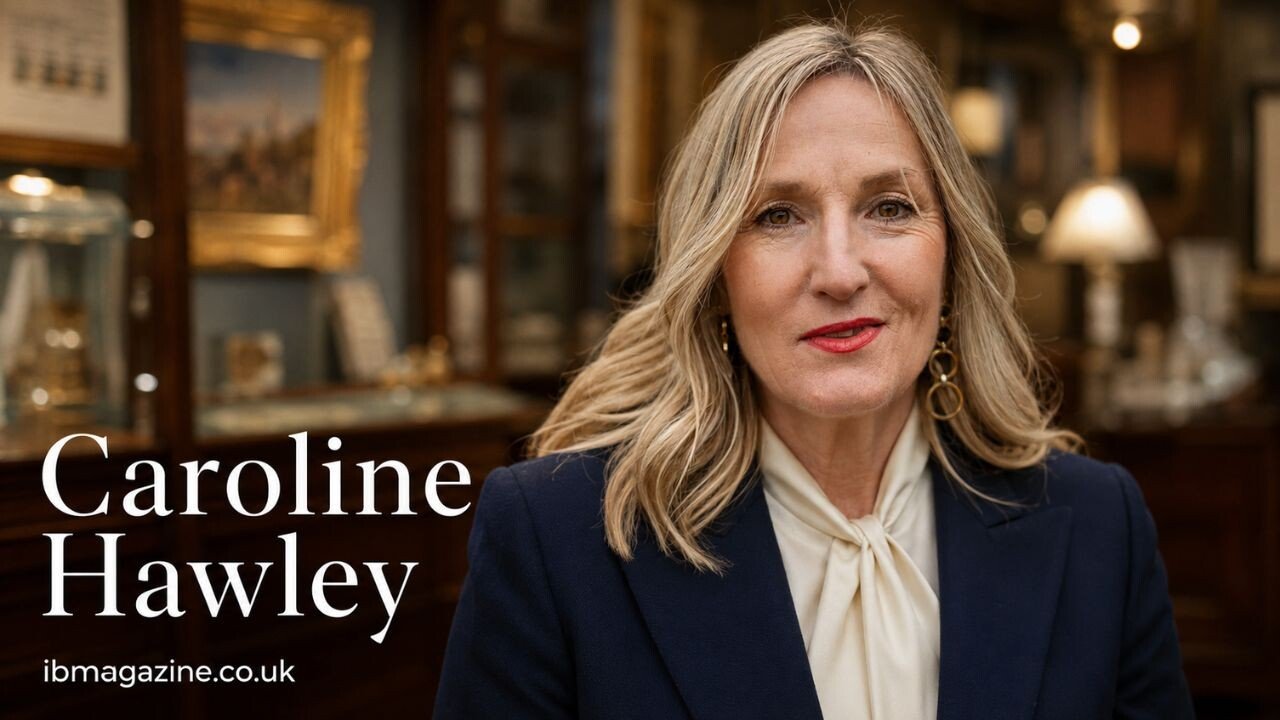
Caroline Hawley is a British auctioneer whose professional connection with antiques stretches back more than four decades. She opened her first shop in South Cave in 1983, later established an East Yorkshire auction house with John Hawley and brought her expertise to television.
Her public profile is closely connected with broadcasting, but her principal career has remained rooted in dealing, valuing and auctioneering. Official corporate records and Hawleys Auctioneers’ own history provide a clear chronology of that work, while her interviews reveal how she approaches collecting, bidding and changes within the industry.
| Field | Details |
|---|---|
| Full name | Caroline Elizabeth Hawley |
| Born | February 1964 |
| Nationality | British |
| Profession | Auctioneer, antiques dealer and television expert |
| First antiques shop | Opened in South Cave in 1983 |
| Business | Hawleys Auctioneers |
| Company roles | Director and company secretary |
| Professional base | North Cave and Beverley, East Yorkshire |
Her First Antiques Shop Opened in South Cave
Caroline Hawley has dealt in antiques for most of her adult life. Hawleys Auctioneers’ professional history records that she opened her first shop in South Cave in 1983 and remained active in the business thereafter. That gives her more than 40 years of documented experience by 2026.
The current business profile does not supply the shop’s original name, although reputable publications have identified it as Penny Farthing Antiques. The securely established details are its South Cave location and the 1983 opening year.
Her interest in old objects began before she entered the trade professionally. In comments attributed to an interview with The Yorkshire Post, she recalled visiting auctions and bring-and-buy sales in her village hall. She also remembered exploring a place where discarded bottles, damaged pieces and other objects from earlier decades could be found.
What caught her attention was not simply the possibility that something might be valuable. She was interested in the people who had previously owned and used each object. That concern with an item’s history remained part of her working approach when examining possessions from house clearances and valuation events.
The move from attending local sales to opening a shop placed that early interest on a professional footing. Rather than entering antiques through a short television opportunity, she had already spent decades buying, selling and studying objects before becoming widely recognised on screen.
Hawleys Auctioneers Became a Family-Run Business
Caroline and John Hawley established Hawleys Auctioneers in 2001, according to the company’s first-party history. Based in East Yorkshire, the independent auction house operates in North Cave and Beverley.
There is an important distinction between the business’s establishment and its formal incorporation. Companies House records show that Hawleys Auctioneers Limited was incorporated on 14 May 2004. Caroline was appointed as both a director and company secretary on 20 May that year, and official records continued to list her as active in both positions in August 2026.
John East Hawley was also appointed as a director on 20 May 2004. He remained in that registered position until resigning on 18 July 2019. His departure from the board did not change the company’s first-party account that he and Caroline established the auction house together.
The family’s involvement expanded when Caroline’s son James joined the business in 2018. Hawleys says his work introduced software systems intended to make its buying and selling procedures more timely, secure and comprehensive. Companies House identifies him as James Cockin and records his appointment as a director on 18 July 2019.
Those dates describe two separate stages of his involvement: joining the auction house in 2018 and taking on a formal directorship the following year. His work also formed part of a broader technological change within a business whose foundations had been laid in traditional shops and salerooms.
Television Expanded Her Work Beyond the Saleroom
Hawley later brought her established knowledge to BBC antiques programming. Her business profile identifies her as one of the broadcaster’s experts, while her professional social-media presence also links her directly with this television work.
Her role on screen grew from practical trade experience. She had already opened her first shop, spent years dealing and helped establish an auction house before becoming familiar to daytime television viewers. On programmes built around buying, valuing and selling objects, she could draw on the same judgement required in her work away from the cameras.
Broadcasting expanded her public audience without replacing her auction-house responsibilities. Hawleys’ current professional information continues to associate her with both media appearances and the management of the business.
The available verified material does not establish her precise television debut through a directly accessible production record. Reputable reporting commonly places the beginning of one of her best-known recurring roles in 2013, but the more firmly documented point is that she has worked for a number of years as a BBC antiques expert while remaining active at Hawleys.
Her Approach to Buying and Collecting Antiques
A 2017 interview with Antique Collecting offered a detailed account of Hawley’s buying philosophy. Her central advice was straightforward: people should not acquire antiques with the expectation of making a guaranteed profit.
Markets can change, and objects that once commanded strong prices may later fall in value. She therefore recommended buying something because it is genuinely liked and can become part of the owner’s life. A future profit may be welcome, but it should not be assumed at the time of purchase.
Her practical guidance was equally important. Buyers should inspect an item before bidding whenever possible or, at minimum, request a condition report. Furniture also needs to be measured carefully. An attractive purchase is of little use if it cannot pass through the intended doorway or fit the available space.
At home, Hawley did not limit herself to a single collecting field. In the same interview, she described an eclectic selection that included patch boxes, samplers and vintage costume. French antiques and decorative objects held particular appeal for her.
Vintage fashion was another significant interest. When asked how she would spend her final £50 on antiques or art, she chose the car-boot sale at York Racecourse as a place to search for vintage designer dresses. She recalled finding a 1950s Christian Dior dress there several years earlier for £4.
That example fits naturally with her wider preference for objects that combine craftsmanship, individual character and an interesting history. It also illustrates the patience involved in searching beyond conventional retail settings, where an overlooked item can occasionally be found at a modest price.
She Has Witnessed the Auction Industry Move Online
Having entered the trade in the early 1980s, Hawley worked through a major shift in the way auctions reached buyers. In her 2017 interview, she identified the arrival of internet bidding as the most significant change affecting the industry.
Online platforms gave regional auction houses access to customers across the world. An object offered in a provincial saleroom no longer depended primarily on interest from buyers able to attend in person. Digital catalogues and remote bidding placed it before a much larger international audience.
That wider visibility also made unnoticed treasures less likely. Items that might once have attracted limited attention could be researched and viewed by specialists or collectors far beyond the auction house’s immediate area.
Hawleys incorporated these developments into its own operations. Its business description says the company embraced internet-bidding platforms and modern technology while retaining personal service and established professional standards. James’s work on internal software from 2018 formed another part of that modernisation.
Hawley nevertheless expressed reservations about an entirely online future. She felt that online-only sales lacked the drama and theatre of a live auction. Detailed condition reports are useful, but in her view they cannot completely replace examining an object in person.
Her position was therefore not a rejection of technology. She recognised its international reach and commercial value while continuing to prefer the physical experience of viewing objects and participating in a live saleroom.
Talks and Charity Auctions Extend Her Public Work
Hawley’s public work is not limited to television. Her auction house says she gives presentations to organisations and groups on a variety of antiques-related subjects. These appearances allow her to discuss collecting, valuation and saleroom experience with audiences outside the normal auction setting.
She also uses her auctioneering skills at charity events. Hawleys describes this as a continuing part of her annual schedule, with live auctions intended to generate the strongest possible return for participating causes.
One recent example was officially documented by Saint Michael’s Hospice. The charity scheduled an evening with Hawley at the Crown Hotel in Harrogate on 16 May 2025. The event was designed around her experiences as an auctioneer and television expert, with guests invited to bring an object for discussion.
A charity auction formed part of the evening, using items donated by local businesses. The advertised proceeds were directed towards Just ‘B’, a service connected with North Yorkshire Hospice Care.
The event placed several parts of her professional work in one setting: discussing collectables, examining objects, engaging with an audience and conducting an auction for a charitable purpose. It also provided recent institutional confirmation that her public activities continued beyond her commercial business and broadcasting appearances.
Her Long Career Remains Rooted in Antiques
Caroline Hawley’s verified career follows a clear line from her first South Cave shop in 1983 to her continuing leadership at Hawleys Auctioneers. The business she established with John Hawley in 2001 developed into a family-run operation, formally incorporated in 2004 and later joined by her son James.
Television introduced her expertise to a wider audience, but it did not displace the auction work behind her public profile. She has continued dealing with objects, managing the company, speaking to groups and conducting charity auctions.
Her own comments add practical substance to that chronology. She values the histories carried by old possessions, advises buyers to choose objects they genuinely appreciate and recognises both the advantages and limitations of online bidding. More than four decades after opening her first shop, the antiques trade remains the consistent centre of her professional life.
You may also read: Tia Kemp’s 2009 Memoir Preceded Her Wider Media Work.